


Freud invented the term EGO to describe the part of us that negotiates between our animal urges (ID) and the ethical/moralistic component of our personality (SUPEREGO). The ego is basically the middle manager of the psyche.
The ego wants to keep the id from throwing a tantrum and the superego from filing an HR complaint.

It is our ego that allows us to plan, make decisions, and navigate reality without collapsing into chaos or guilt or paralysis.
It is our EGO that says, “I am me; I matter.”
It is our EGO that organizes experience into story.
It is our EGO that guides us in making realistic choices.

Ego = indispensable

I think that if the ego was reduced to just one job it would be to resist mortality. The entire job description just might be:
pretend it’s permanent
pretend I matter
pretend that I persist
The ego doesn’t fear pain so much as it fears the end of its story. It’s addicted to narrative — the rise and the fall and the redemption arc. Death doesn’t deliver closure; it just yanks the plug mid-monologue. No grand finale, no credits, just the lights snapping on. So we invent sequels: afterlives, legacies, art, children, archives — anything to pretend the show goes on.
But we know, don’t we. Die we must.
At least at one level we know.
Ernest Becker’s book The Denial of Death (1974) won the Pulitzer Prize for a reason: he saw civilization as a kind of mass coping mechanism — a beautifully coordinated distraction from the fact that we’re all going to die. Art, religion, philosophy — all elegant ways of saying, “I will persist.” Every cathedral is mortality in disguise, every monument a polite refusal to disappear. (I explore this in detail in my upcoming book, You’re Going to Die But Not Me, Pierian Springs Press, Spring 2026)
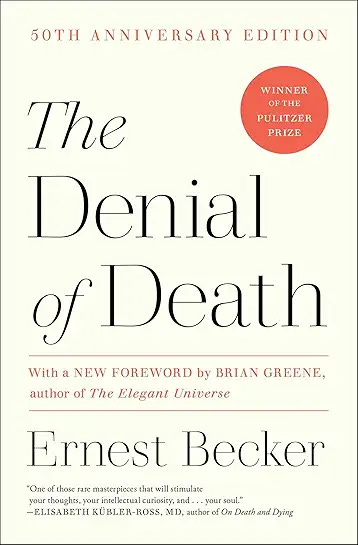
Becker describes what he calls our “immortality projects” which he sees as the ways we humans attempt—mostly at an unconscious level—-to obscure the truth of the human condition. We try to cheat death symbolically — to feel that something of “me” continues after the body stops. These can be heroic, creative, or delusional. Things like:
- We attach ourselves to something bigger and more enduring than the individual self
- We pour our essence into art, ideas, or accomplishments — the things that supposedly last
- We have children…..the oldest and most primal stab at it
- We form beliefs in afterlife, reincarnation, heaven, and enlightenment
Immortality projects are the ego’s attempt to evade the delete key.

BUT
I’m sure you can see the irony here: our terror of death creates much of the suffering we work so hard to avoid.
Which brings me to EGO DEATH because without the ego would there be any anxiety about dying?
There are many philosophical traditions that speak to the concept of ego death.
Buddhism
Hinduism
Mystical Christianity
Taoism
Existential and Phenomenological Philosophy
Psychedelic and Transpersonal Psychology
Non-dual Philosophy
In fact, when I took yoga for about 2 seconds, I remember being told that corpse pose (SAVASANA) was a kind of death rehearsal.
Maybe every spiritual practice is a death rehearsal. 🤷♀️🤷♀️
Here is a quote from Ram Dass: “When the ego is gone, death loses its sting.”
This short article from MasterClass describes stages of ego death and here is an article from a Jungian perspective that explores the concept of egocide.
And now for something beautiful: this is an excerpt from Mary Oliver’s poem, Roses, Late Summer, which to me, speaks to this concept of ego and death:

If I had another life
I would want to spend it all on some
unstinting happiness.
I would be a fox, or a tree
full of waving branches.
I wouldn’t mind being a rose
in a field full of roses.
Fear has not yet occurred to them, nor ambition.
Reason they have not yet thought of.
Neither do they ask how long they must be roses, and then what or any other foolish question.
And now some fascinating videos on the subject:
